
Ford Mustang II (1974-1978)

This Ford Mustang II King Cobra was driven by Kurt Russell in Guardians of the Galaxy Vol. 2 and is on Display at The Pedersen Museum. They can also be spotted in all time greats such as Stranger Things, Charlie's Angels, Starman and many more. Photograph by Ted7.
Engines Across the Mustang II Era
1974
-
2.3L I4 (88 hp) — first metric American engine, SOHC, cross‑flow head
-
2.8L Cologne V6 (105 hp) — smooth but modest performance
-
No V8 available
1975–1978
-
5.0L / 302 V8 returns (140–139 hp depending on year)
-
Reintroduced in 1975
-
Power modest due to emissions controls
-
-
2.3L I4 continues
-
2.8L V6 continues until 1976
-
New 2.8L V6 with improved induction for 1977–78 in some trims
The return of the V8 helped restore some of the Mustang’s performance identity, though output remained limited by mid‑70s regulations.
Model Lineup by Trim (1974–1978)
Base Model (Hardtop & 2+2 Hatchback)
Available all years
-
Simplest and lightest Mustang II
-
Standard gauges (tach, fuel, alternator, temp)
-
Non‑reclining bucket seats
-
2.3L I4 standard; V6 or V8 optional depending on year
-
Served as the foundation for all other trims
Ghia (1974–1978) — The Luxury Mustang
Replacing the earlier Grande, the Ghia trim emphasised comfort and European‑influenced elegance.
Key features (varying by year):
-
Vinyl roof
-
Plush velour or upgraded vinyl interiors
-
Additional sound insulation
-
Color‑keyed remote mirrors
-
Pinstriping
-
Styled steel wheels or wire‑style wheel covers
-
Wood‑tone interior accents
-
Optional sunroof
The Ghia was consistently the most comfort‑oriented Mustang II.
Mach 1 (1974–1978) — The Sport Appearance Model
The Mach 1 returned as the sporty Mustang II variant, though performance varied by year.
1974 Mach 1
-
Standard 2.8L V6
-
Unique lower body graphics
-
Rallye Package required for maximum capability
-
Traction‑Lok
-
Wide‑oval radials
-
Competition Suspension
-
Extra cooling
-
Styled steel wheels
-
Leather‑wrapped wheel
-
1975–1978 Mach 1
-
V8 becomes optional (and popular)
-
Revised striping and graphics
-
Improved suspension tuning
-
Available in bold late‑70s color combinations
The Mach 1 remained visually aggressive but was more about style than raw performance.
Built in an era of fuel crisis and silly regulation this sweet little Mustang II got a bad rap, but don't let that fool you - the Ford Mustang II is a thoroughbred with various engine options, body styles and trim packages and this site is dedicated to this car, and has a wealth of information for owners and enthusiasts.
Where possible the images on this site are actually Mustang II owners own vehicles which are lovingly maintained and cared for.
The Mustang II represented a dramatic shift from the original Mustang formula. Introduced for 1974, it was smaller, more refined, and engineered for a new era shaped by fuel shortages, emissions regulations, and changing consumer expectations. Although it retained classic Mustang styling cues—long hood, short deck, sculpted sides, and a familiar grille—the Mustang II was fundamentally a different car beneath the surface.
Design & Body Styles
Across all five model years, the Mustang II was offered in two body styles:
-
Two‑door hardtop
-
Three‑door 2+2 hatchback
No convertible was offered during the Mustang II era. The design emphasised compact dimensions, improved visibility, and a more European‑influenced sense of proportion.
Mechanical Architecture
The Mustang II introduced several major engineering changes:
-
New front suspension with coil springs mounted between the control arms
-
Isolated front subframe to reduce vibration and improve refinement
-
Rack‑and‑pinion steering (a first for Mustang)
-
Front disc brakes standard
-
Staggered rear shocks for improved stability
-
Four‑speed manual transmission standard, with optional automatic
These changes made the Mustang II quieter and more precise than its predecessors, aligning with Ford’s goal of a more sophisticated personal car.

1978 Mustang II RHD
1978 Mustang II from the UK (RHD)

Mustang II Ghia Black

1978 Mustang II Cobra from Switzerland
Stunning 5.0 V8 ’78 Cobra owned by Christophe.
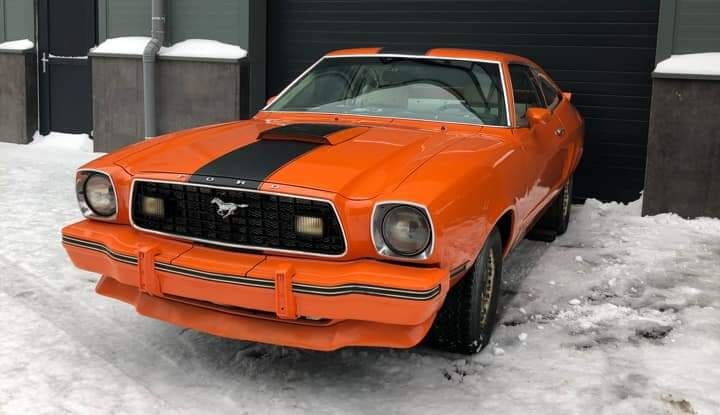
1976 Mustang II Cobra from the Netherlands
Gorgeously Orange ’76 Cobra 2.8 V6 owned by Martijn.
Cobra II (1976–1978) — Retro‑Racer Styling
Introduced in 1976, the Cobra II capitalised on the popularity of Shelby‑style graphics.
Features included:
-
Bold stripes (often blue-on-white or black-on-gold)
-
Hood scoop
-
Front and rear spoilers
-
Quarter window louvers
-
Cobra snake badging
-
Optional V8
The Cobra II was one of the most recognisable Mustang II variants and a pop‑culture icon of the late 1970s.
King Cobra (1978 Only) — The Wild One
The rarest and most aggressive Mustang II.
Key features:
-
5.0L V8 standard
-
Large “snake” hood decal
-
Unique front air dam
-
Rear spoiler
-
Blacked‑out trim
-
Wide graphics package
-
Limited production (approx. 4,300 units)
The King Cobra represented the peak of Mustang II performance and styling before the Fox‑body Mustang replaced it in 1979.